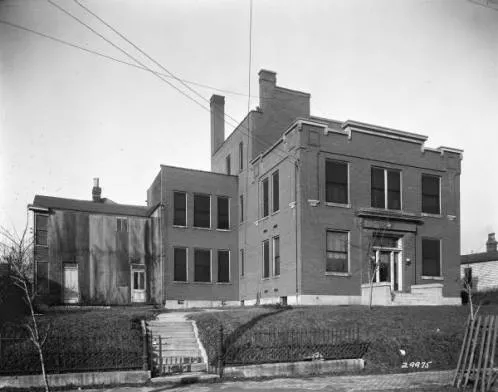
Red Cross Hospital, 1436 South Shelby Street
Red Cross Hospital
Louisville's First and Largest African American Hospital — A Cornerstone of Black Healthcare for 76 Years
For over seven decades, Red Cross Hospital was the only place in Kentucky where Black patients could receive comprehensive medical care and Black physicians could fully practice their profession. Founded in 1899 by physicians barred from white hospitals, it grew from four beds in a frame house to a fully accredited 100-bed institution — powered by community fundraising, staffed by dedicated professionals, and beloved by the people it served.
Born from Exclusion
In 1899, Black physicians in Louisville faced an impossible reality: they were trained to practice medicine, but barred from practicing it. No public or church hospital in the city would allow them to treat patients. The only options for Black Louisvillians seeking medical care were the indigent wards at Louisville General Hospital or, for tuberculosis, Waverly Hills Sanatorium.
Drs. W.T. Merchant, Ellis D. Whedbee, and R.B. Scott decided to build their own answer. They founded Red Cross Hospital — not affiliated with the international humanitarian organization — in a small four-room residence at 6th and Floyd Streets. It had four beds and one nurse. It was modest, underfunded, and it was everything.
In 1905, the hospital moved to 1436 South Shelby Street, where it would remain for the next seven decades. From this location, Red Cross Hospital grew into the cornerstone of Black healthcare in Kentucky.
Surviving on Determination
Red Cross Hospital never had it easy. Financial problems plagued the institution from the beginning, and the 1930s and 1940s were particularly brutal. The hospital lost its certification to train nurses. Equipment became obsolete. The laboratory stopped functioning.
But the staff refused to let it die. Nurses collected invoices, washed windows, and scrubbed floors. Physicians purchased drugs at retail prices from local pharmacies and brought their own instruments because the hospital had none. Staff were never invited to professional seminars, so they read on their own to stay current. The hospital accepted patients regardless of their ability to pay and kept them until they were well.
"It was what every medical institution should be. It was compassionate, the patients loved it, the community loved it, they contributed to it financially as best they could, and it followed all of the Hippocratic traditions: relief from pain, relief from suffering, and do the best you can as a physician." Dr. Morris Weiss, medical historian — KET, 2016
The community rallied around its hospital. Dinners, raffles, church groups, and civic organizations banded together to keep Red Cross alive. Their efforts paid off — the hospital steadily grew, and so did the community pride invested in an institution they had built and sustained themselves.
Physicians, Nurses, Pioneers
Red Cross Hospital was shaped by extraordinary individuals who dedicated their lives to an institution the rest of the medical world ignored.
Mary E. Merritt, R.N. served as Superintendent of Nursing from 1914 to 1945 — thirty-one years. She ran the only nursing training program for Black women in Kentucky until 1937. Medical historian Dr. Morris Weiss called her "the hospital" itself: "She took care of the patients, she was an administrator, she was an organizer, and she kept everybody's morale high, and kept the doctors in line."
Dr. John H. Walls practiced at Red Cross from 1918 until his retirement in the late 1960s. His oral histories, recorded in 1977, are among the most important primary sources documenting the hospital's history. He was also instrumental in the fight to integrate the Jefferson County Medical Society in 1953.
Dr. Jesse Bell, Dr. J.A.C. Lattimore, and Dr. C. Milton Young Jr. were among the physicians who served the hospital during its most challenging decades, providing care to a community that had nowhere else to turn.
Red Cross Hospital employed only Black physicians and staff until 1953, when the integration of the Jefferson County Medical Society allowed for a more open flow of medical professionals between hospitals. Even after integration, Red Cross remained the heart of Black healthcare in Louisville.
From Four Beds to One Hundred
By the mid-1940s, a determined effort was underway to modernize Red Cross. A new board of trustees assembled a professional team: administrator, medical director, superintendent of nurses, records clerk, laboratory technician, dietitian, bookkeeper, and x-ray technician. A fundraising campaign brought all new equipment into the hospital, and the bed count grew from 38 to 54.
Near the end of the 1940s, Red Cross achieved a remarkable distinction: it became the only private African American hospital in the nation approved by the American Cancer Society to operate a cancer clinic. A team of specialists treated ten patients twice a month.
In 1951, a $650,000 new wing was built, nearly doubling capacity to 100 beds. The addition included five operating rooms, two nurseries, a complete x-ray suite, clinical laboratory, dental clinic, laundry, and heating plant. By 1965, Red Cross Hospital had earned full accreditation from the Joint Commission on Accreditation of Hospitals and memberships in the American Hospital Association, Kentucky Hospital Association, Ohio Valley Hospital Conference, and Louisville Hospital Council.
Success Became Its Own Undoing
The very victory that FCMS members had fought for — the integration of Louisville's medical institutions — paradoxically undermined the hospital they had built. As hospitals, clinics, and medical schools opened their doors to African Americans in the 1950s and 1960s, Black patients and physicians gradually dispersed into the broader system.
In the early 1970s, Red Cross changed its name to Community Hospital in an attempt to compete with larger institutions that had more advanced technology and equipment. But by 1975, the hospital was $50,000 in debt and unable to maintain capacity. After 76 years of service, the institution closed its doors.
The loss was deeply felt. In his oral histories, Dr. Bell spoke about what the closing meant to the community — and the apparent lack of loyalty that had developed as integration opened other options. The institution that had served as the training ground, the employer, the caregiver, and the source of community pride for generations was gone.
The building at 1436 South Shelby Street still stands today.
76 Years of Service
Drs. W.T. Merchant, Ellis D. Whedbee, and R.B. Scott found Red Cross Hospital in a four-room residence at 6th and Floyd Streets — four beds, one nurse.
Hospital moves to 1436 South Shelby Street, its permanent home for seven decades.
Red Cross Sanitarium opens alongside the hospital, expanding services.
Mary E. Merritt becomes Superintendent of Nursing and begins a 31-year tenure running the only Black nursing school in Kentucky.
Black nurses including Merritt care for soldiers during the Spanish Flu pandemic at Camp Taylor; Dr. John Walls begins practicing at Red Cross.
Nursing training program closes due to financial hardship; it later reopens in 1948.
Major modernization: new board, new staff, new equipment, and bed count rises from 38 to 54.
Becomes the only private African American hospital in the nation approved by the American Cancer Society to operate a cancer clinic.
$650,000 new wing built, nearly doubling capacity to 100 beds with five operating rooms.
Integration of Jefferson County Medical Society opens white hospitals to Black physicians for the first time.
Earns full accreditation from the Joint Commission on Accreditation of Hospitals.
Renamed Community Hospital in an attempt to remain competitive.
Closes after 76 years of service — $50,000 in debt and unable to maintain capacity.
Norton West Louisville Hospital unveils a monument honoring the physicians and nurses of Red Cross Hospital.
The Hospital That FCMS Built
Red Cross Hospital and Falls City Medical Society were inseparable. The hospital was one of FCMS's earliest achievements — born from the same generation of Black physicians who chartered the society in 1902. For decades, the two institutions reinforced each other: FCMS provided the professional framework and collective voice, while Red Cross provided the facility where that profession could actually be practiced.
The physicians who built FCMS practiced at Red Cross. The integration they fought for in 1953 changed Red Cross's trajectory. The community health ethos that defined Red Cross — compassionate care, treating patients regardless of ability to pay, training the next generation — is the same ethos that drives FCMS today.
The building still stands at 1436 South Shelby Street. The institution it housed may be gone, but its legacy lives on in every FCMS community health fair, every scholarship awarded, and every Black physician practicing in Louisville today.
Further Reading
Filson Historical Society — Red Cross Hospital: History of Service, A Photographic Record, 1898–1988, two volumes of scrapbooks compiled by J. Scott Lux.
University of Louisville Oral History Center — Dr. John H. Walls, Dr. Jesse Bell, and Dr. C. Milton Young III oral histories.
Kentucky Historic Institutions — Red Cross Hospital.
ExploreKYHistory — Historical Marker #2534, Red Cross Hospital.
KET Kentucky Health — African American Health Care in Louisville with Dr. Morris Weiss, 2016.
Clio — Red Cross Hospital by Matthew Mooser, University of Louisville, 2017.
WHAS11 — monument coverage for early Louisville Black doctors at Norton West Louisville Hospital, October 2024.
Red Cross Hospital Is Gone. Its Mission Lives On.
Falls City Medical Society carries forward the same commitment to community health, physician excellence, and equitable care.
Join FCMS