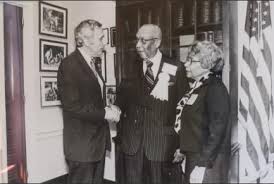
Dr. Jesse Bell
Dr. Jesse Bell
Chest Disease Specialist, Medical Director of Red Cross Hospital, First Black Physician at Jewish Hospital, International Scholar, and Lifelong Advocate for Community Health
Dr. Jesse Bell turned personal adversity into a life's calling. After contracting tuberculosis early in his career, he became one of Kentucky's leading chest disease specialists, modernized Red Cross Hospital from the inside, broke the color barrier at Jewish Hospital, and spent 94 years proving that courage and compassion could overcome any system designed to exclude.
His oral histories, recorded in 1977, and his personal papers — preserved at the Filson Historical Society — are among the most important records of Black medical history in Louisville.
From Tallulah to Morehouse to Meharry
Jesse Bell was born on April 20, 1904, in Tallulah, Louisiana — a small town in the Mississippi Delta where opportunities for Black residents were defined by the brutal constraints of the Jim Crow South. But Bell was determined to pursue medicine.
He earned his Bachelor of Science degree from Morehouse College in Atlanta, Georgia — the institution that would also educate Martin Luther King Jr. — and then his Doctor of Medicine from Meharry Medical College in Nashville, Tennessee, in 1931. Like so many Black physicians of his generation, Meharry was the gateway: the institution that trained more Black doctors than any other in America.
After graduating, Bell opened a practice in Frankfort, Kentucky, where he worked alongside the respected Dr. E.E. Underwood, whose reputation was so sterling that he treated some of the best families in the capital city, regardless of race. Bell later recalled that Underwood was historically rated as the second or third Black physician to practice in Kentucky.
Illness as Calling
After nearly two years in Frankfort, Dr. Bell's life took an unexpected turn: he contracted tuberculosis. He moved to Louisville to receive treatment at Waverly Hills Sanatorium — the imposing hilltop facility that was one of the few places in Kentucky that would treat Black tuberculosis patients.
While recovering, something shifted inside him. Rather than being defeated by the disease, Bell decided to devote his entire career to public health, focusing specifically on chest diseases and lung ailments. His own suffering became the foundation of his specialty.
In 1935, after his recovery, Bell became one of the first Black physicians to work at Waverly Hills itself — returning to the institution that had saved his life, now as a physician. In 1943, he became a member of the American College of Chest Physicians. In 1958, he was the only physician from the Kentucky and Indiana region to attend the Fifth International Conference on Diseases of the Chest in Japan — a measure of how far his expertise had carried him from the Delta town where he was born.
Rebuilding from Within
Dr. Bell became involved with Red Cross Hospital in the early 1940s — a period when the institution was struggling. He was hired as the hospital's first Medical Director in 1941, and immediately set to work modernizing the facility.
Working with Louisville's Director of Health, Dr. Hugh Levet, Bell raised $21,000 — roughly $337,000 in today's dollars — for hospital improvements. That money funded new staff, laboratory and x-ray technology, sixteen additional beds, and updated equipment. He helped reopen the nursing school in 1948 after it had been closed for eleven years. He brought on a new wave of professional staff: a dietitian, bookkeeper, records clerk, and a reconstituted board of trustees.
Under Bell's medical directorship from 1942 to 1946, and continuing through his years of influence, Red Cross Hospital achieved milestones that would have seemed impossible a decade earlier. The American Cancer Society certified it to operate a cancer clinic — making it the only private African American hospital in the nation with that distinction. The $650,000 Heyburn Building addition in 1951 nearly doubled capacity to 100 beds. By 1965, the hospital earned full Joint Commission accreditation.
"It was what every medical institution should be. It was compassionate, the patients loved it, the community loved it, they contributed to it financially as best they could, and it followed all of the Hippocratic traditions." Dr. Morris Weiss — on Red Cross Hospital under Bell's era of leadership
Jewish Hospital and Beyond
In 1958, Dr. Bell became the first Black physician to receive staff privileges at Jewish Hospital in Louisville — breaking the color barrier at a white hospital for the first time in the city's history. Along with Dr. Maurice Rabb, who received privileges around the same time, Bell became living proof that integration was not just a principle to be argued — it was a reality to be demonstrated.
Slowly, other Louisville hospitals began to receive Black patients and welcome Black doctors during the 1960s and 1970s. Bell did not just walk through the door — he led. In 1980, he became the first Black president of the Jewish Hospital medical staff, a position of real authority at the institution that had once excluded physicians who looked like him.
In 1965, Bell was named the first African American on the University of Louisville Board of Overseers — bringing Black representation to the governance of the very university system that had excluded Black students from its medical school for decades.
Beyond the Hospital Walls
Dr. Bell's impact extended far beyond his medical practice. He was a member of Falls City Medical Society and the Jefferson County Medical Society. He served as past president of the American Heart Association of Louisville and Jefferson County. He sat on the Kentucky Thoracic Society, the Bureau of Health Services for Kentucky, and the Ursuline College Advisory Committee.
As chair of the Kentucky Commission on Higher Education, Bell advocated for expanding access to education — the same cause that had defined Louisville's Black medical community since Fitzbutler lobbied the legislature for a medical school charter in 1888.
He launched the first program in Kentucky to screen minorities and residents of low-income communities for high blood pressure — bringing preventive medicine into communities that had historically been served only in crisis. In 1983, the American Heart Association recognized his work with an award for outstanding service in minority health programs.
In 1947, after stepping down as Medical Director of Red Cross, Bell opened a private practice that he maintained for decades — continuing to serve the community that had been at the center of his life since he arrived in Louisville as a young man fighting tuberculosis.
The Record He Left Behind
Dr. Bell's friendship with Dr. Morris Weiss — a white cardiologist who worked alongside prominent Black physicians from Red Cross Hospital early in his career — became one of the most important relationships in the preservation of Louisville's Black medical history. Weiss formed a lifelong bond with Bell and his family, and it was this friendship that drove Weiss to spend decades researching and documenting the stories of Red Cross Hospital, Falls City Medical Society, and the physicians who built them.
In 1977, Bell sat for extensive oral history recordings at the University of Louisville, speaking about Red Cross Hospital's development, the nursing program, integration, fundraising, the care patients received, and — most poignantly — the loss the community felt when the hospital closed in 1975. He spoke about what he called the apparent lack of loyalty that had developed as integration opened other options, and the complex emotions surrounding an institution that had been both a lifeline and a source of immense community pride.
Dr. Bell married Geneva Howard in 1936. He died on November 27, 1998, in Louisville, at the age of 94. His papers — spanning 1924 to 1998, including correspondence, awards, certificates, and minutes from the Louisville Lung Association and Louisville Memorial Hospital Board of Governors — are preserved at the Filson Historical Society.
He lived long enough to see the world he had helped build: a Louisville where Black physicians practiced at every hospital, sat on every medical board, and led institutions that had once barred them from entry. He did not just witness that transformation — he made it happen.
94 Years of Service
Born April 20 in Tallulah, Louisiana.
Earns MD from Meharry Medical College after completing his BS at Morehouse College.
Contracts tuberculosis while practicing in Frankfort and moves to Louisville for treatment at Waverly Hills Sanatorium.
Becomes one of the first Black physicians to work at Waverly Hills and devotes his career to chest diseases.
Marries Geneva Howard Bell.
Becomes Medical Director of Red Cross Hospital and begins a transformative modernization campaign.
Elected member of the American College of Chest Physicians.
Opens private practice in Louisville after stepping down as Medical Director.
Becomes first Black physician with staff privileges at Jewish Hospital and attends the Fifth International Conference on Diseases of the Chest in Japan.
Named first African American on the University of Louisville Board of Overseers.
Records oral histories at the University of Louisville documenting Red Cross Hospital and the integration struggle.
Becomes first Black president of Jewish Hospital medical staff.
Receives American Heart Association award for outstanding service in minority health programs in Kentucky.
Dies November 27 in Louisville at the age of 94; his papers are preserved at the Filson Historical Society.
From Red Cross to Every Hospital in Louisville
Dr. Bell opened doors that had been locked for generations. Falls City Medical Society keeps them open.
Join FCMS