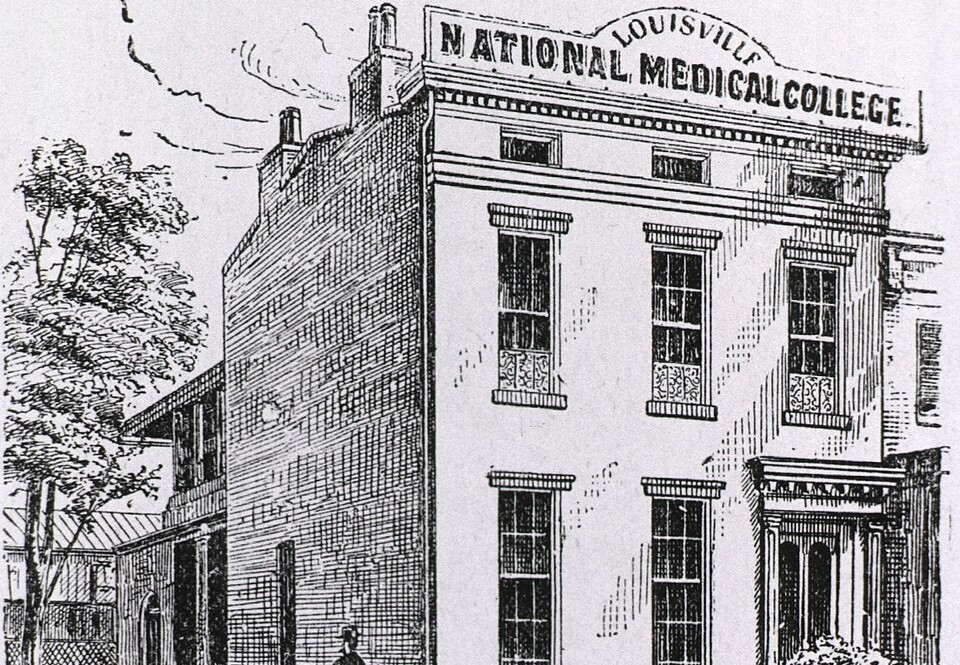
Louisville National Medical College
Louisville National Medical College
The Only African American Medical School Entirely Owned and Operated by African Americans — 175 Graduates in 24 Years
At a time when none of Louisville's four other medical schools would accept Black students, Dr. William Henry Fitzbutler lobbied the Kentucky Legislature, secured a charter, and built a medical college that would train 175 Black physicians over 24 years. It was the finest African American medical school in the country — and its closure after the Flexner Report was one of the great losses in the history of American medical education.
Four Schools, Zero Access
In 1888, Louisville was home to four medical schools. Not one of them would accept Black students. For an aspiring Black physician in Kentucky, the only options were to leave the state entirely — to travel to Nashville for Meharry, to Washington for Howard, or to abandon the dream altogether.
Dr. William Henry Fitzbutler refused to accept this. A civil rights activist as much as a physician, he lobbied the Kentucky Legislature until it was persuaded to grant approval for a new institution. With the support of Dr. W.A. Burney of New Albany, Indiana, and Dr. Rufus Conrad, Fitzbutler secured a charter and founded the Louisville National Medical College.
The college was initially housed in the United Brothers of Friendship Hall at Ninth and Magazine Streets in Louisville before later moving to Green Street. From the beginning, it was built on a radical premise: that Black physicians could not only be trained to the highest standards, but that Black professionals could own and operate the institution that trained them.
The Fitzbutlers at the Helm
Dr. Fitzbutler served as Dean, Chair of Surgery, Chair of Materia Medica, and majority owner of the college. He led the institution with a vision of expanding opportunity and excellence in medical training, setting standards that rivaled the best schools in the country.
His wife, Sarah Helen McCurdy Fitzbutler, enrolled in the college and became its first female graduate — making her the first African American woman to earn a medical degree in Kentucky. She went on to become Supervisor of Nurses, taught obstetrics and pediatrics, and supervised the nursing program. After Henry's death in 1901, Sarah continued leadership of both the college and its hospital for eleven more years.
Dr. Artishia Garcia Gilbert Wilkerson, another graduate, returned to teach obstetrics at the college and became superintendent of the associated Red Cross Sanitarium — demonstrating the pipeline the college created: training physicians who then came back to train more.
"It became the best United States African-American medical college, and the only one owned and operated entirely by African-Americans." University of Louisville School of Medicine — Fitzbutler College
Training Beyond the Classroom
In 1894, Fitzbutler established Louisville Hospital as an adjunct to the medical college, housed in two buildings neighboring the school. This wasn't just a teaching facility — it was a working hospital that provided direct care to Louisville's Black community while giving students the clinical experience essential to becoming competent physicians.
The hospital also included a dispensary, ensuring that even those who couldn't afford care could receive it. Together, the college and hospital formed a complete ecosystem: education, training, and service, all under one roof, all serving a community that had been abandoned by the mainstream medical establishment.
Sarah Fitzbutler became superintendent of the auxiliary hospital on Madison Street, overseeing both patient care and the nursing training program. Under her leadership, the hospital earned a reputation for cleanliness and quality that would later be formally recognized.
Praised and Destroyed
In 1909, Abraham Flexner — a Louisville native — conducted his landmark inspection tour of American medical schools on behalf of the Carnegie Foundation. His report, published in 1910, would reshape medical education across the country, closing schools that failed to meet his standards.
Flexner's assessment of Louisville National Medical College was paradoxical. He found the hospital to be one of the cleanest and best-run in the entire country — a remarkable achievement for an institution operating with minimal resources in a segregated society. Yet the report also deemed the college "ineffectual" and argued that medical education for Black Americans needed reform.
The curricular changes mandated in response to the Flexner Report were devastating for Black medical education. Schools needed larger teaching hospitals, more equipment, and more faculty — resources that were systematically denied to Black institutions. Of the seven Black medical schools operating in 1910, only Howard and Meharry would survive. The Louisville National Medical College closed in 1912.
For over forty years afterward, aspiring Black physicians in Kentucky had to leave the state entirely to receive medical training.
What the College Produced
In its 24 years of operation, the Louisville National Medical College graduated 175 physicians. Many went on to serve communities across the country that otherwise lacked access to care. The first graduate, William T. Peyton, received his degree in 1889 — just one year after the college opened.
The college also trained nurses, operated a hospital and dispensary, and served as a hub of civic and professional life for Louisville's Black medical community. Its graduates didn't just practice medicine — they built institutions, advocated for civil rights, and mentored the next generation.
The college briefly shared Louisville's medical education landscape with the State University Medical College, which operated from 1899 until merging with Simmons University in 1907. After Simmons closed in 1912, the training hospital became the Simmons Nursing Department — another thread in the interconnected fabric of Black medical education in Louisville.
24 Years of Excellence
Dr. William Henry Fitzbutler secures a charter from the Kentucky Legislature and founds Louisville National Medical College — the only Black-owned and operated medical school in America.
William T. Peyton becomes the college's first graduate.
Sarah Helen McCurdy Fitzbutler graduates — the first African American woman to earn a medical degree in Kentucky.
Artishia Garcia Gilbert graduates — later becoming the first Black woman licensed to practice medicine in Kentucky.
Louisville Hospital is established in two buildings adjacent to the college for clinical training and community care.
Dr. Henry Fitzbutler dies at 59; Sarah Fitzbutler takes over leadership of both the college and hospital.
The college merges administratively with Simmons University.
Abraham Flexner inspects the college and praises the hospital as one of the cleanest in the country.
The Flexner Report is published, mandating reforms that disproportionately close Black medical schools.
Louisville National Medical College closes after 24 years and 175 graduates; aspiring Black physicians in Kentucky must leave the state for the next four decades.
The School That Made FCMS Possible
Louisville National Medical College didn't just train physicians — it created the professional community that gave rise to Falls City Medical Society. The physicians it graduated were the founders and early members of FCMS. The hospital it operated was the precursor to Red Cross Hospital. The ethos it embodied — that Black professionals could build, own, and operate institutions of excellence — became the foundation of everything FCMS would do for the next century.
Today, the University of Louisville School of Medicine honors the Fitzbutlers by naming one of its advisory colleges "Fitzbutler College." The University of Michigan Medical School has a "Fitzbutler House" honoring Henry as one of its pioneering alumni. And Falls City Medical Society continues the work that began in a rented hall on Ninth and Magazine Streets in 1888 — training, mentoring, and supporting Black physicians in Louisville.
The Louisville National Medical College may have closed in 1912, but its graduates, its values, and its vision are alive in every FCMS scholarship awarded, every Pathways to Medicine event held, and every Black physician practicing in Louisville today.
Further Reading
University of Louisville School of Medicine — Fitzbutler College.
Kentucky Historic Institutions — Louisville National College of Medicine.
Notable Kentucky African Americans Database — Louisville National Medical College.
U.S. National Library of Medicine — Louisville National Medical College faculty portrait and archival images.
Flexner Report — Medical Education in the United States and Canada, Carnegie Foundation, 1910.
Kleber, John E., et al. — The Encyclopedia of Louisville, University of Kentucky Press, 2001.
Weiss, Morris M., MD — "History of Louisville National Medical College and the Red Cross Hospital," Louisville Medicine, April 2013.
University of Louisville Archives and Special Collections — Louisville National Medical College records.
175 Graduates Started It. You Can Continue It.
The Louisville National Medical College trained the physicians who built FCMS. Help build the next generation.
Join FCMS